If you haven't priced Legos in the last few years, you probably don't realize that they're absurdly expensive. I'm not sure if they've always been this bad, but decent-sized sets now easily retail for more than $100 and anything in the $20-$30 range is too small to be worth buying.
The problem with buying Legos is that it's pretty much guaranteed that pieces will be missing. This is fine if you're buying them for yourself to build without instructions or to add to a box of mixed Legos. When I was in college, I bought a bag of a few hundred pieces for my dorm to play around with. If you're buying with the intention of having a whole set (either for yourself or as a gift) then you're making a mistake unless you can get them for really cheap.
I've heard that Legos can sell for quite a bit of money on eBay, especially if they come with the box and directions. This is especially true for older sets and some of the more popular themes, like Star Wars. Of course, this requires you to find a full set.
If you have a lot of time on your hands and don't mind making money fifty cents at a time, you can also sell individual pieces on eBay to people who are missing their own pieces. You can sell the pieces for anywhere from 99 cents to a few dollars, but after shipping (even a first class envelope) your profit will be small.
You most likely won't find Legos at garage sales. In the last year I've seen them twice and both times they were too expensive to purchase. Still, if you're looking for a relatively cheap gift or you don't mind spending a little more on yourself, you may get lucky.
Showing posts with label Items to Look For. Show all posts
Showing posts with label Items to Look For. Show all posts
Friday, November 9, 2012

Wednesday, July 18, 2012
Items to Look for: Video Game Guides
I've been continuing in my push to get rid of as much of my unwanted possessions as possible that I mentioned back in December. Going through my bookshelf, I found some old N64 player's guides (Prima's Guides, etc.).
Out of curiosity, I checked their value on Amazon. Some of them, as I expected, were valued at $0.01 but to my surprise, most were in the $15-$20 range. Two cost more than $50 each.
Like textbooks and video games, the market isn't predictable. If you can get them for $0.10 each and they end up worthless, you can just sell them at your own garage sale or try to Craigslist them. This is yet another class of items for which a smartphone is a very useful tool -- just use it to check the book's value on Amazon before you commit to purchasing it.
It my browsing of player's guides on Amazon, I have noticed a correlation: valuable games tend to have valuable player's guides. The original Paper Mario is one example of a game that fits this trend.
Out of curiosity, I checked their value on Amazon. Some of them, as I expected, were valued at $0.01 but to my surprise, most were in the $15-$20 range. Two cost more than $50 each.
Like textbooks and video games, the market isn't predictable. If you can get them for $0.10 each and they end up worthless, you can just sell them at your own garage sale or try to Craigslist them. This is yet another class of items for which a smartphone is a very useful tool -- just use it to check the book's value on Amazon before you commit to purchasing it.
It my browsing of player's guides on Amazon, I have noticed a correlation: valuable games tend to have valuable player's guides. The original Paper Mario is one example of a game that fits this trend.
Thursday, April 26, 2012
Items to Look for: Printer Cartridges
One item I've been seeing more frequently at garage sales is printer cartridges. As I'm sure you know, printer ink is absurdly expensive, so why not buy that $0.25 factory sealed instead of spending $40 on it at the store? Just be sure to note what cartridges your printer uses so you don't end up with a bunch of ink that won't work with your printer.
For whatever reason, HP ink is definitely the most common at sales. This leads me to believe that HP printers are most commonly used or the most likely to fail unexpectedly. I do also see Brother and Canon ink on occasion.
For whatever reason, HP ink is definitely the most common at sales. This leads me to believe that HP printers are most commonly used or the most likely to fail unexpectedly. I do also see Brother and Canon ink on occasion.
Tuesday, April 24, 2012
Items to Look for: Textbooks, Continued
On Saturday I discussed criteria for determining if a textbook is a good investment. Today I'm going to talk about pricing textbooks for both buying and selling.
When buying books, it's important to know if it's worth the investment before you purchase it. As I said in my last post, if the book is older than four years, don't bother checking it; it's almost guaranteed to be outdated.
What's worth the investment varies from person to person. If I can get a book for $0.10 to resell it for a $7.50 profit, I'm fine with that. Some people require larger profits to be bothered to list the book, take it to the post office, etc. Remember that Amazon's fees and shipping add up quickly; your profit is equal to the books selling price * (1 - 0.15 in fees) - the book's initial cost (ie, how much you paid for it at the garage sale) - $2.34 in fees + $3.99 shipping credit - ~$3-$5 shipping fees. So, if you sell a book you bought for $2 for $20 on Amazon, you're really only making ~$12.50 after shipping. It's important you do the math before you make the purchase so you don't end up making an investment that loses you money.
When buying textbooks, it's very important you don't overspend. Had you spent $10 on that hypothetical textbook from above, your profit would drop to less than $5. Like everything else, be conservative: try to make your purchase as cheap as possible.
Personally, unless I am very sure I can sell the textbook very quickly for a fair sum, I am unwilling to invest more than $0.15 on it. Spending $0.50 on a book on March 3rd in which I had no idea of its value was very unusual for me; usually in this situation I wouldn't spend more than $0.10. For whatever reason I felt like taking a gamble; it paid off as the book sold for more than $28 after fees and shipping.
I employ two venues for selling textbooks: Amazon and Craigslist. I use Amazon when I'm more interested in a quick sale than I am in making a little more money; I also use it when I have failed to find a buyer on Craigslist. Like selling on Craigslist, the trade-off effect is very present: you are more likely to get more money if you're willing to wait.
Textbook prices on Amazon don't seem to fluctuate like video game prices, so listing your book in the middle and simply waiting for it to be sold doesn't seem to work. I have noticed, however, that people are willing to spend more for a book in better condition or for a book from a seller with good feedback. Obviously, don't lie about the book's condition (this will only get you negative feedback), but a good way to build good feedback is to list like-new books at the low price.
When pricing a book on Amazon, I usually don't list it at the lowest price. Instead, I price it six to eight cents cheaper than the fifth or sixth cheapest copy. This way, I'm still on the first page of used copies but I'm making a few more dollars than sellers at the top of the list.
I sell books on Craigslist in the following situations:
When buying books, it's important to know if it's worth the investment before you purchase it. As I said in my last post, if the book is older than four years, don't bother checking it; it's almost guaranteed to be outdated.
What's worth the investment varies from person to person. If I can get a book for $0.10 to resell it for a $7.50 profit, I'm fine with that. Some people require larger profits to be bothered to list the book, take it to the post office, etc. Remember that Amazon's fees and shipping add up quickly; your profit is equal to the books selling price * (1 - 0.15 in fees) - the book's initial cost (ie, how much you paid for it at the garage sale) - $2.34 in fees + $3.99 shipping credit - ~$3-$5 shipping fees. So, if you sell a book you bought for $2 for $20 on Amazon, you're really only making ~$12.50 after shipping. It's important you do the math before you make the purchase so you don't end up making an investment that loses you money.
When buying textbooks, it's very important you don't overspend. Had you spent $10 on that hypothetical textbook from above, your profit would drop to less than $5. Like everything else, be conservative: try to make your purchase as cheap as possible.
Personally, unless I am very sure I can sell the textbook very quickly for a fair sum, I am unwilling to invest more than $0.15 on it. Spending $0.50 on a book on March 3rd in which I had no idea of its value was very unusual for me; usually in this situation I wouldn't spend more than $0.10. For whatever reason I felt like taking a gamble; it paid off as the book sold for more than $28 after fees and shipping.
I employ two venues for selling textbooks: Amazon and Craigslist. I use Amazon when I'm more interested in a quick sale than I am in making a little more money; I also use it when I have failed to find a buyer on Craigslist. Like selling on Craigslist, the trade-off effect is very present: you are more likely to get more money if you're willing to wait.
Textbook prices on Amazon don't seem to fluctuate like video game prices, so listing your book in the middle and simply waiting for it to be sold doesn't seem to work. I have noticed, however, that people are willing to spend more for a book in better condition or for a book from a seller with good feedback. Obviously, don't lie about the book's condition (this will only get you negative feedback), but a good way to build good feedback is to list like-new books at the low price.
When pricing a book on Amazon, I usually don't list it at the lowest price. Instead, I price it six to eight cents cheaper than the fifth or sixth cheapest copy. This way, I'm still on the first page of used copies but I'm making a few more dollars than sellers at the top of the list.
I sell books on Craigslist in the following situations:
- I know the book is used at a university in my area
- It's an older edition or it's worthless on Amazon
- I don't mind holding on to the book to potentially make more money
First of all, it's almost guaranteed you will make more money selling books on Craigslist than you will on Amazon. I've had people pay me $40 on Craigslist for a book that starts at $0.01 on Amazon. Furthermore, many students are willing to buy older versions of their books; I've had many students happy to spend $30 for the 4th edition of a book in its 4th edition that costs $150.
Perhaps the best part about selling books on Craigslist is that there's little competition. You can set your book at $50 and people will offer $40 and be happy, whereas on Amazon the book may start at $20 and there may be thirty sellers trying to sell the book for $20-$50; in this situation your copy would never even be looked at at $50.
I usually base my Craigslist asking price on the lowest Amazon price for the current edition of the book. I usually price my copy two and a half times the Amazon low price; so, for example, if the Amazon low price is $30, I will list it at $80 with a disclaimer that I will consider all reasonable offers. This way, the buyer will offer $50 and I will counter at $60. I still walk away with a good profit (even better considering I didn't have to pay Amazon's fees) and the buyer is happy.
If the Amazon low for a textbook is less than $5 I will list my copy at $20. If someone offers $10 I'll take it.
Saturday, April 21, 2012
Items to Look for: Textbooks
For those of you who don't know, the modern textbook industry is a rather exploitative institution. Textbooks are frequently updated with new editions to make using used books more difficult (frequently the only changes between editions are changed homework sections) and expensive. A typical college textbook costs anywhere from $120-$250 depending on the subject. When I was in college I had one book listed at $350 (I didn't buy it).
The only good thing about the textbooks being so expensive is that their resale value is pretty high. Many students do not bother (or don't know) to sell their books on Craigslist or Amazon if their university bookstore won't buy them back at the end of the semester. They hold onto the books and eventually sell them for cheap at garage sales (after all, as far as the student knows the books are worthless). You can then buy them and resell them.
I have a pretty strong understanding of the textbook market. In the last calendar year I've made over $500 selling other people's textbooks. In summer of 2010 I made over $1500 selling textbooks. The trick to making money on textbooks is being good at judging if a book is worth anything. Following is a list of things to keep in mind when looking at textbooks at garage sales:
The only good thing about the textbooks being so expensive is that their resale value is pretty high. Many students do not bother (or don't know) to sell their books on Craigslist or Amazon if their university bookstore won't buy them back at the end of the semester. They hold onto the books and eventually sell them for cheap at garage sales (after all, as far as the student knows the books are worthless). You can then buy them and resell them.
I have a pretty strong understanding of the textbook market. In the last calendar year I've made over $500 selling other people's textbooks. In summer of 2010 I made over $1500 selling textbooks. The trick to making money on textbooks is being good at judging if a book is worth anything. Following is a list of things to keep in mind when looking at textbooks at garage sales:
- Copyright date is the first indicator I use to determine if a book is worth anything. When I find a stack of books, I sort through them and discard anything with a copyright date more than four years in the past. As I said above, textbooks are replaced with new editions quickly; four years is about the maximum time between editions. Once you've looked at enough textbooks you can tell which books are older, especially books from the 80's or 90's. Don't even bother picking up books that old
- Subject is my next criteria. Different subjects have different rates of replacement. New editions of social science textbooks come out as frequently as every year or two. Engineering textbooks (which are far less common at garage sales) are replaced every four to five years on average. Math books are replaced every three to four years it seems. Unfortunately, the most common books at garage sales are social science texts.
- Use your smart phone, if you have one. If I'm garage saling with someone who owns a smart phone, after my initial narrowing of the pile by copyright date I'll just check all the books that have come out in the last four years. It's easy to just scan the barcode and check Amazon for the book. Be sure you're looking at the used price and not the used price when buying a book though. One of my friends found a book that he thought sold for $160 on Amazon. When he rechecked it he realized he was looking at Amazon's new price; used copies started at $0.01.
- If you have checked the book on Amazon and it's an older edition, don't make the purchase. It's not worth it.
- If you don't have a smart phone (or you're not saling with someone who owns one) you need to be more selective. You have no way of checking a book's value so there's a very large possibility of purchasing a worthless item. When I'm in this situation, I will only buy books with a copyright date from this year or the previous year.
- Book condition should also be taken into account when buying books. Really, condition doesn't really matter if you're selling a book on Craigslist; I've sold some pretty beaten-up dumpster books and never received a complaint. On Amazon, however, condition is more important because people can give you negative feedback. Negative feedback means worse sales in the future. If a book has torn pages or a torn cover, sticky or missing pages, or excessive dirt, don't buy it.
I was going to discuss pricing textbooks to sell but I think I'll cover that on Tuesday. This post is long enough.
Saturday, April 14, 2012
Items to Look for: Books
Books are some of the most common items at garage sales; in fact, many times the only thing stopping us from doing a drive by at a sale is a stack of books.
The great thing about books at garage sales is that you can get them for really cheap; as I've mentioned before, I try to get at least five for a dollar but I will never pay more than $0.25 per book.
The downside to buying books at garage sales from garage sales is that it can be very frustrating. Nine times out of ten, books are either of the self-help Christian variety, the Dan Brown-esque variety, or romance novels (if these excite you I am judging you very, very hard right now).
I would say I buy a book every other week I go saling. About every two months we go to a sale with a good book selection and I buy five or more books. Really, like everything else in garage saling, it's just a matter of getting lucky.
The great thing about books at garage sales is that you can get them for really cheap; as I've mentioned before, I try to get at least five for a dollar but I will never pay more than $0.25 per book.
The downside to buying books at garage sales from garage sales is that it can be very frustrating. Nine times out of ten, books are either of the self-help Christian variety, the Dan Brown-esque variety, or romance novels (if these excite you I am judging you very, very hard right now).
I would say I buy a book every other week I go saling. About every two months we go to a sale with a good book selection and I buy five or more books. Really, like everything else in garage saling, it's just a matter of getting lucky.
Wednesday, April 4, 2012
Items to Look for: Video Games
As you probably know, video games, even used video games, are expensive. Garage sales are great for buying games because you can get them for a fraction of their used price, frequently a dollar or less per game. I'm not saying you're going to see games every week you go out; many weekends I don't see any games at all. However, when you do see sales with games, they're usually selling a few games, not just one.
When I see a stack of games at a sale, I usually grab the whole thing and make an offer on it. Why? For several reasons.
For one, if the seller denies my offer, I can take out one or two games I definitely do not want (usually sports games, I hate sports games) as a bargaining tactic. I take out the games, offer the same sum I offered previously, and frequently the seller will agree. If the seller accepts my initial offer, then I get a couple games I don't really want. I can either give these to Goodwill or hang onto them to bundle them into my next game/console sale.
Another reason is for reselling. I've bought some fairly valuable games ($20 range) in the past in game bundles at sales. If you get lucky like that, you can sell one game, keep the rest, and make a profit. As I mentioned above, if you get a few games in which you are not interested and they prove worthless, bundle them together and sell them at your own garage sale. I've had parents and grandparents buying games for their children or grandchildren pay quite a bit for worthless games at my own sales. Worthless games that I bought in bundles and kept the good games.
Obviously, this works best if you're buying games for yourself or you know a fair bit about games and you intend to gift or resell them. I know the popular SNES and N64 games and I know what games for these consoles will get you decent money. I will buy games for myself for other consoles but I won't buy games for other consoles to resell because I don't know the markets.
When I see a stack of games at a sale, I usually grab the whole thing and make an offer on it. Why? For several reasons.
For one, if the seller denies my offer, I can take out one or two games I definitely do not want (usually sports games, I hate sports games) as a bargaining tactic. I take out the games, offer the same sum I offered previously, and frequently the seller will agree. If the seller accepts my initial offer, then I get a couple games I don't really want. I can either give these to Goodwill or hang onto them to bundle them into my next game/console sale.
Another reason is for reselling. I've bought some fairly valuable games ($20 range) in the past in game bundles at sales. If you get lucky like that, you can sell one game, keep the rest, and make a profit. As I mentioned above, if you get a few games in which you are not interested and they prove worthless, bundle them together and sell them at your own garage sale. I've had parents and grandparents buying games for their children or grandchildren pay quite a bit for worthless games at my own sales. Worthless games that I bought in bundles and kept the good games.
Obviously, this works best if you're buying games for yourself or you know a fair bit about games and you intend to gift or resell them. I know the popular SNES and N64 games and I know what games for these consoles will get you decent money. I will buy games for myself for other consoles but I won't buy games for other consoles to resell because I don't know the markets.
Tuesday, April 3, 2012
Items to Look for: Nerf Guns
I'm going to start a series discussing common items that are potential great deals, either from a reselling standpoint or a buy for one's self standpoint. I'm also going to start a related series of items to avoid; at least one item will appear on both lists.
Today's topic is Nerf guns. Why? Nerf guns have been the single most profitable category of resale items I have come across. I have made at least $170 off them since I started reselling Nerf guns back in 2008 and I have an additional $40-$60 worth of guns sitting in my sister's room (it's OK, she's away at college).
The great thing about Nerf guns is that most people think they're worthless. Of the $170+ in guns I have sold, I invested a total of less than $3. If people are willing to sell their guns for cheap, they're going to let them go for almost free. At one sale, I traded a few foreign coins (all worthless, mainly Canadian pennies) for guns I later resold for $35.
Some guns are worth more than others. The Longshot is fairly common and, having been discontinued in the US, is worth up to $60 on eBay, as I've mentioned before. The Longshot comes in the original blue, yellow, and red. The red version was sold as the Red Strike only on Black Friday 2009 at Wal-mart. All version of this gun will fetch a fair amount of money but the Red Strike is considered to be very valuable.

The Vulcan is another gun considered to be worth a fair amount. It's a fully-automatic, tripod-mounted gun that uses six C batteries. Don't spend much buying this gun; two of the three I have purchased proved to be broken and you can't really check if it works if the seller doesn't have fresh batteries. A working Vulcan will get you $35-$40.

Today's topic is Nerf guns. Why? Nerf guns have been the single most profitable category of resale items I have come across. I have made at least $170 off them since I started reselling Nerf guns back in 2008 and I have an additional $40-$60 worth of guns sitting in my sister's room (it's OK, she's away at college).
The great thing about Nerf guns is that most people think they're worthless. Of the $170+ in guns I have sold, I invested a total of less than $3. If people are willing to sell their guns for cheap, they're going to let them go for almost free. At one sale, I traded a few foreign coins (all worthless, mainly Canadian pennies) for guns I later resold for $35.
Some guns are worth more than others. The Longshot is fairly common and, having been discontinued in the US, is worth up to $60 on eBay, as I've mentioned before. The Longshot comes in the original blue, yellow, and red. The red version was sold as the Red Strike only on Black Friday 2009 at Wal-mart. All version of this gun will fetch a fair amount of money but the Red Strike is considered to be very valuable.

The Longshot
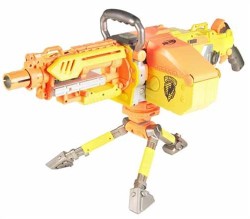
The Vulcan
Other guns will fetch your varying amounts of money. According to my reading, the crossbow is considered one of the best Nerf guns ever made but I have no idea how much money you can get for it. The Nerf Wiki is a great site for pricing and listing Nerf guns; I always use it when flipping guns (it's also where I'm getting my information for this post).
One great thing about Nerf guns is that you frequently buy them in sets. People on Craigslist are unwilling to spend more than $5 per gun if they're sold individually; however, if the guns come in a set, they are willing to pay more. A set of four guns, depending on the model, will usually get you between $25 and $50.
Subscribe to:
Posts (Atom)